This is a concordance module that will assess the types of specialty care received by and
quality of specialty data found in a study sample. The user will provide a
clinical codeset of interest (codeset_tbl) with an associated domain
and will be able to stratify results by: visit type
(with user-provided groupings in visit_type_tbl), cluster
(an additional column added to codeset_tbl with subgroupings), or time
Usage
cnc_sp_process(
  cohort,
  multi_or_single_site = "single",
  anomaly_or_exploratory = "exploratory",
  omop_or_pcornet,
  age_groups = NULL,
  codeset_tbl,
  care_site = FALSE,
  provider = TRUE,
  visit_detail = FALSE,
  visit_type_tbl = NULL,
  time = FALSE,
  time_span = c("2012-01-01", "2020-01-01"),
  time_period = "year",
  vocab_tbl = NULL
)
Arguments
- cohort
tabular input || required
The cohort to be used for data quality testing. This table should contain, at minimum:
site| character | the name(s) of institutions included in your cohortperson_id/patid| integer / character | the patient identifierstart_date| date | the start of the cohort periodend_date| date | the end of the cohort period
Note that the start and end dates included in this table will be used to limit the search window for the analyses in this module.
- multi_or_single_site
string || defaults to
singleA string, either
singleormulti, indicating whether a single-site or multi-site analysis should be executed- anomaly_or_exploratory
string || defaults to
exploratoryA string, either
anomalyorexploratory, indicating what type of results should be produced.Exploratory analyses give a high level summary of the data to examine the fact representation within the cohort. Anomaly detection analyses are specialized to identify outliers within the cohort.
- omop_or_pcornet
string || required
A string, either
omoporpcornet, indicating the CDM format of the dataomop: run thecnc_sp_process_omop()function against an OMOP CDM instancepcornet: run thecnc_sp_process_pcornet()function against a PCORnet CDM instance
- age_groups
tabular input || defaults to
NULLIf you would like to stratify the results by age group, create a table or CSV file with the following columns and use it as input to this parameter:
min_age| integer | the minimum age for the group (i.e. 10)max_age| integer | the maximum age for the group (i.e. 20)group| character | a string label for the group (i.e. 10-20, Young Adult, etc.)
If you would not like to stratify by age group, leave as
NULL- codeset_tbl
tabular input || required
A table defining the clinical event of interest, containing the following:
domain| character | a string label for the domain where the event is defineddomain_tbl| character | the name of the CDM table where the event is definedconcept_field| character | the string name of the field in the domain table where the concepts are locateddate_field| character | the name of the field in the domain table with the date that should be used for temporal filteringcodeset_name| character | name of the codeset with concepts defining the clinical event
The codeset file identified by this table can optionally contain a
clustercolumn specifying subgroups of the codeset, and if so, the results will be stratified by clusterTo see an example of the structure of this file, see
?clinicalevents.specialties::cnc_sp_codeset_file- care_site
boolean || defaults to
FALSEA boolean indicating whether care site/facility specialty values should be included in the analysis. If both
providerandcare_siteare TRUE, provider specialty will be prioritized.- provider
boolean | defaults to
TRUEA boolean indicating whether care provider specialty values should be included in the analysis. If both
providerandcare_siteare TRUE, provider specialty will be prioritized.- visit_detail
boolean || defaults to
FALSEFor OMOP analyses only – a boolean indicating whether the visit_detail table should be used as the primary visit table to identify specialty visits. If left FALSE, visit_occurrence will be used.
- visit_type_tbl
tabular input || defaults to
NULLA table defining available visit types to be used as an optional stratification. This table should contain the following field:
visit_concept_id/visit_detail_concept_idorenc_type| integer / character | the visit type identifier that represents the visit type of interest (ex: 9201 or IP)visit_type| character | a string description of the visit type
To see an example of the structure of this file, see
?clinicalevents.specialties::cnc_sp_visit_file_omopor?clinicalevents.specialties::cnc_sp_visit_file_pcornet- time
boolean || defaults to
FALSEA boolean to indicate whether to execute a longitudinal analysis
- time_span
vector - length 2 || defaults to
c('2012-01-01', '2020-01-01')A vector indicating the lower and upper bounds of the time series for longitudinal analyses
- time_period
string || defaults to
yearA string indicating the distance between dates within the specified time_span. Defaults to
year, but other time periods such asmonthorweekare also acceptable- vocab_tbl
tabular input || defaults to
NULLA vocabulary table containing concept names that will be used to retrieve labels for the specialty concepts (ex: the OMOP concept table)
Value
This function will return two dataframes:
A table containing all of the specialties associated with the clinical event, which can be further grouped by the user before feeding this into the cnc_sp_output function
A table containing counts of visits, optionally stratified by visit, cluster, and/or time period, with each specialty for the visits meeting criteria (i.e. those with the clinical fact provided)
For a more detailed description of output specific to each check type, see the PEDSpace metadata repository
Examples
#' Source setup file
source(system.file('setup.R', package = 'clinicalevents.specialties'))
#' Create in-memory RSQLite database using data in extdata directory
conn <- mk_testdb_omop()
#' Establish connection to database and generate internal configurations
initialize_dq_session(session_name = 'cnc_sp_process_test',
working_directory = my_directory,
db_conn = conn,
is_json = FALSE,
file_subdirectory = my_file_folder,
cdm_schema = NA)
#> Connected to: :memory:@NA
## Turn off SQL trace for this example
config('db_trace', FALSE)
#' Build mock study cohort
cohort <- cdm_tbl('person') %>% dplyr::distinct(person_id) %>%
dplyr::mutate(start_date = as.Date(-5000),
#RSQLite does not store date objects,
#hence the numerics
end_date = as.Date(15000),
site = ifelse(person_id %in% c(1:6), 'synth1', 'synth2'))
#' Prepare input tables
cnc_sp_visit_tbl <- dplyr::tibble(visit_concept_id = c(9201,9202,9203),
visit_type = c('inpatient', 'outpatient', 'emergency'))
cnc_sp_concept_tbl <- dplyr::tibble(domain = 'Hypertension',
domain_tbl = 'condition_occurrence',
concept_field = 'condition_concept_id',
date_field = 'condition_start_date',
vocabulary_field = NA,
codeset_name = 'dx_hypertension')
#' Execute `cnc_sp_process` function
#' This example will use the single site, exploratory, cross sectional
#' configuration
cnc_sp_process_example <- cnc_sp_process(cohort = cohort,
omop_or_pcornet = 'omop',
multi_or_single_site = 'single',
anomaly_or_exploratory = 'exploratory',
codeset_tbl = cnc_sp_concept_tbl,
visit_type_tbl = cnc_sp_visit_tbl,
time = FALSE) %>%
suppressMessages()
#> ┌ Output Function Details ─────────────────────────────────────────┐
#> │ You can optionally use this dataframe in the accompanying │
#> │ `cnc_sp_output` function. Here are the parameters you will need: │
#> │ │
#> │ Always Required: cnc_sp_process_output, cnc_sp_process_names │
#> │ Required for Check: top_n │
#> │ Optional: facet_vars, specialty_filter │
#> │ │
#> │ See ?cnc_sp_output for more details. │
#> └──────────────────────────────────────────────────────────────────┘
cnc_sp_process_example$cnc_sp_process_output
#> # A tibble: 1 × 7
#> specialty_concept_id cluster visit_type codeset_name num_visits site
#> <dbl> <chr> <chr> <chr> <int> <chr>
#> 1 38004446 Essential hyper… outpatient dx_hyperten… 5 comb…
#> # ℹ 1 more variable: output_function <chr>
cnc_sp_process_example$cnc_sp_process_names
#> # A tibble: 1 × 2
#> specialty_concept_id specialty_concept_name
#> <dbl> <chr>
#> 1 38004446 No vocabulary table input
#' Execute `cnc_sp_output` function
cnc_sp_output_example <-
cnc_sp_output(cnc_sp_process_output =
cnc_sp_process_example$cnc_sp_process_output,
cnc_sp_process_names =
cnc_sp_process_example$cnc_sp_process_names %>%
dplyr::mutate(specialty_name = 'General Pediatrics'),
facet_vars = c('visit_type')) %>%
suppressMessages()
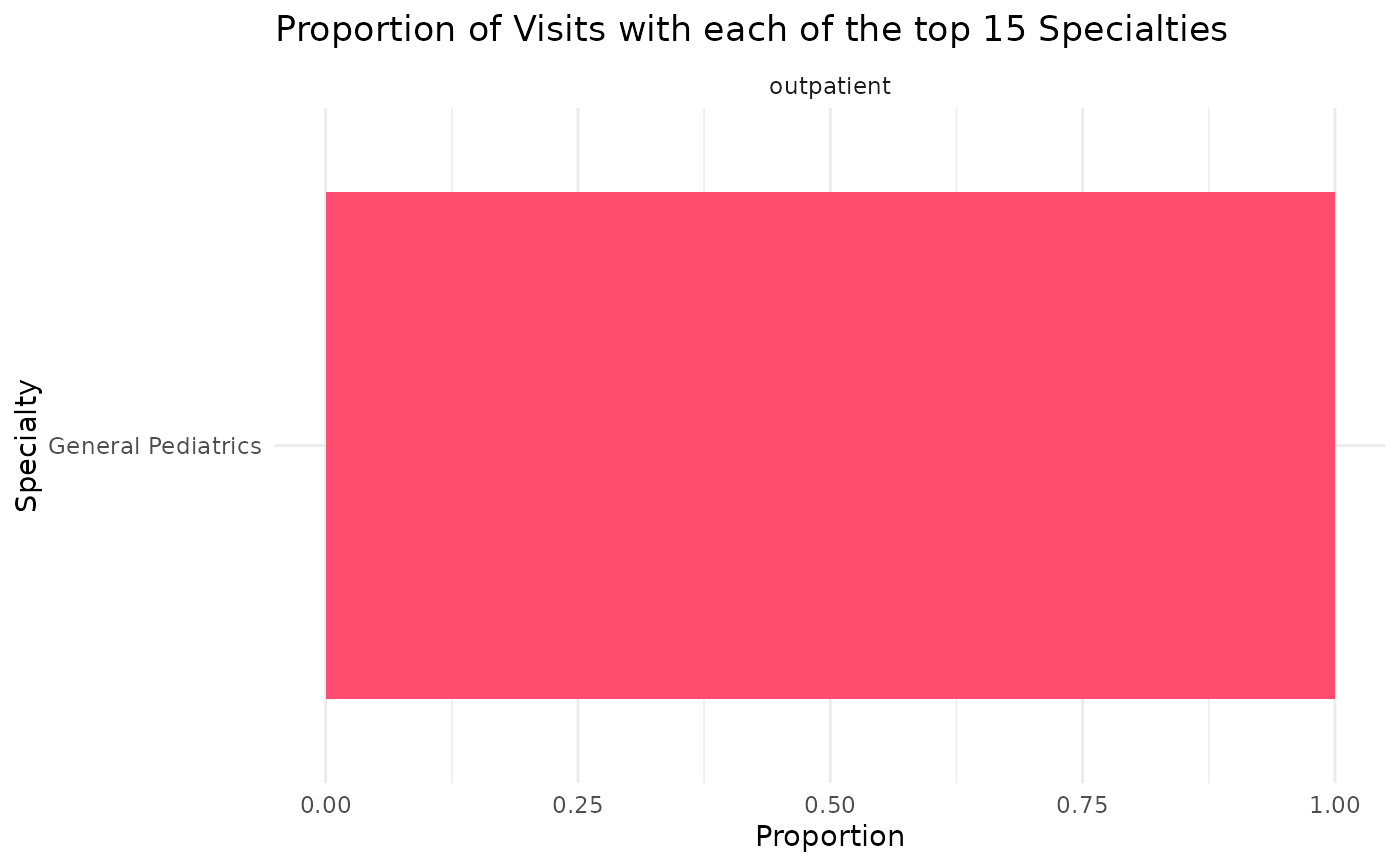
cnc_sp_output_example
 #' Easily convert the graph into an interactive ggiraph or plotly object with
#' `make_interactive_squba()`
make_interactive_squba(cnc_sp_output_example)
#' Easily convert the graph into an interactive ggiraph or plotly object with
#' `make_interactive_squba()`
make_interactive_squba(cnc_sp_output_example)